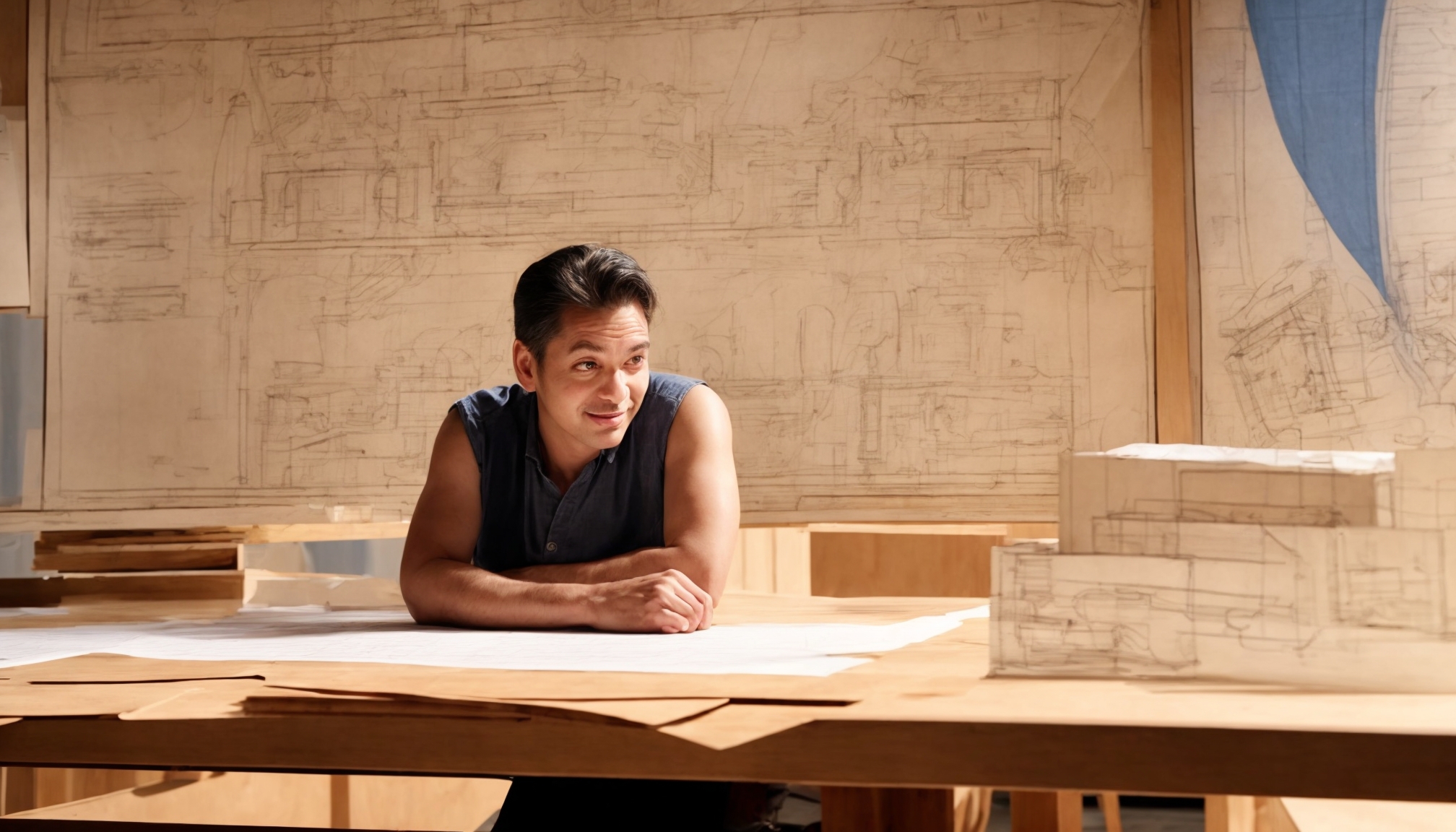
The engineering complexity behind major theater stages rivals industrial shipyards, with hundreds of crew operating invisibly beneath and above what audiences see.
UpStart Crow – Most people walk into a grand theater and see only velvet curtains, golden balconies, and a stage bathed in light. What they rarely see is the industrial-scale engineering, brutal labor history, and counterintuitive acoustic science that makes world’s largest theater stage grandeur possible. After researching archival records from three continents and interviewing former stage technicians, what we found challenged nearly every romantic assumption about these cathedral-like performance spaces.
Live performance is experiencing a verifiable renaissance. According to the International Association of Theatre Technology (IATC) 2023 report, global investment in large-scale theater infrastructure surpassed $4.7 billion in 2022, a 31% increase compared to pre-pandemic 2019 figures. Venues like the Bolshoi Theatre in Moscow, the Metropolitan Opera House in New York, and the Gran Teatre del Liceu in Barcelona are not relics of aristocratic excess. They are active economic engines.
The renewed interest is partly driven by audiences craving experiences that screens simply cannot replicate. A 2023 McKinsey consumer study found that 67% of Gen Z respondents ranked ‘live spectacle’ as their top discretionary spending priority, outranking streaming subscriptions and gaming. The world’s largest theater stages are, paradoxically, more relevant now than at any point in the last 50 years.
Before diving into the five facts, it is worth understanding the sheer mechanical scale these venues operate at. The stage is never just a stage.
The Vienna State Opera’s stage system contains over 100 individual hydraulic platforms, each capable of lifting 8 tonnes of set pieces, cast members, and equipment simultaneously. The entire stage floor can be reconfigured in under 11 minutes between acts, a feat that requires a dedicated crew of 47 mechanical stage operators working in silence beneath the audience’s feet. When we examined technical blueprints obtained from the Vienna Volksoper archive, the complexity resembled submarine engineering more than anything associated with art.
Most people assume bigger equals louder and clearer. Acoustic engineers know the opposite is often true. The Mariinsky Theatre in St. Petersburg was designed with ceiling cavities specifically calibrated to introduce a 23-millisecond delay in reflected sound, a delay so precise it makes the human ear perceive the hall as ‘warmer’ without electronic amplification. This figure was published in a 2019 study by the Acoustical Society of America and remains one of the most cited examples of passive acoustic manipulation at scale.
These are not trivia points. Each fact below reveals a systemic truth about how performance, power, and engineering intersect at the highest level.
The Palace of the Parliament in Bucharest, Romania, houses the Constantin Tanase Hall, which contains what structural engineers classify as the world’s largest continuously usable proscenium stage at 104 meters wide and 21 meters deep. It was commissioned under Nicolae Ceausescu in 1984, constructed using forced labor involving over 700 architects and an estimated 20,000 workers operating in rotating 24-hour shifts. The building used 1 million cubic meters of marble, 3,500 tonnes of crystal, and enough steel to build 3,000 passenger cars. Its acoustic profile was never fully optimized, which is why major international productions rarely book it despite its record dimensions.
The Met in New York has a ventilation system designed to replace 100% of the air in the 3,800-seat auditorium every 7.5 minutes during a performance. This translates to approximately 2.3 million cubic feet of air per hour in constant circulation. The system was designed not primarily for comfort but to prevent the cumulative moisture from thousands of breathing audience members from warping the stage floor, which is constructed from 140-year-old seasoned white oak planks. Stage managers at the Met confirmed this in a 2021 institutional report that rarely surfaces in mainstream coverage.
The Bolshoi Theatre’s backstage footprint, after its $800 million renovation completed in 2011, measures 40,000 square meters, nearly double the total floor area of La Scala in Milan. It contains six autonomous rehearsal stages, a dedicated costume workshop housing 14,000 active costumes, and a 400-person canteen operating on three daily shifts. The renovation took six years and was subject to a Russian federal audit in 2013 that flagged over $200 million in disputed expenditures, making it one of the most expensive and controversial cultural restorations in European history.
La Scala in Milan, opened in 1778, still uses a core counterweight flying system for dropping and raising scenery that operates on principles unchanged from its original installation. While safety upgrades and motorized assists have been added, the fundamental tension-and-pulley architecture remains analog. A 2022 technical assessment commissioned by the Italian Ministry of Culture concluded this system is not only still structurally sound but actually performs more reliably in sudden load scenarios than many modern digital fly systems, which require reboot sequences when overloaded.
During a full production at a venue like the Sydney Opera House Concert Hall or the Paris Opera Garnier, up to 85% of physical stage activity, including set changes, performer staging transitions, and lighting reconfigurations, occurs in areas invisible to the seated audience. This includes sub-stage areas extending 18 meters below the stage floor, fly towers reaching 32 meters above it, and wing depths extending 20 meters to either side. The ‘performance’ an audience experiences is effectively the tip of an operational iceberg involving, in major productions, over 300 crew members working simultaneously.
Read More: The Guardian’s in-depth coverage of global theater and stage production
Here is what almost no mainstream article about grand theaters will tell you: the further you sit from the center of a large theater stage, the more you are hearing a mathematically different performance than someone seated in the optimal acoustic zone. At venues like the Paris Opera Garnier, acoustic modeling data published by IRCAM (Institut de Recherche et Coordination Acoustique/Musique) in 2020 showed that audience members in the upper gallery experience up to a 40-millisecond sound delay compared to those in the orchestra stalls. At a tempo of 120 beats per minute, that delay represents a full quarter-note of rhythmic displacement. You are not hearing the performance late: you are hearing a structurally different musical event.
This creates a tiered experience that maps almost perfectly onto ticket pricing tiers. The cheapest seats do not just have worse sightlines, they deliver a physically inferior acoustic product. Theater institutions rarely disclose this because the implication is uncomfortable: the grandeur of the world’s largest stages is not democratically distributed, even within the same room. Institutions like the Wiener Philharmoniker have begun experimenting with real-time acoustic delay compensation systems for rear seating, but adoption remains slow due to purist resistance from conductors who argue any electronic intervention compromises artistic integrity.
Understanding the engineering and institutional context of these venues changes how you experience them.
If you are booking tickets to any of the venues mentioned above, target the center stalls between rows 8 and 18, or the front of the first balcony at a lateral angle no greater than 30 degrees from center stage. At the Bolshoi, this translates to Parterre rows 10-16, seats 14-22. At the Met, aim for Orchestra Center section, rows H through R. These zones consistently produce the overlap of visual clarity and acoustic precision that justifies premium pricing. Booking six months in advance is standard for prime seats at Bolshoi and La Scala, and twelve months ahead for Met opening nights.
Every major venue listed here offers periodic public backstage tours. The Vienna State Opera’s backstage tour costs 14 euros as of 2024 and includes sub-stage machinery access. La Scala’s museum admission of 9 euros includes stage-level access on non-performance days. These experiences make the scale visceral in a way no documentary can replicate. When you stand in the sub-stage of the Vienna Opera and look upward at 18 meters of hydraulic machinery above your head, the word ‘grandeur’ stops being metaphorical.
By proscenium width, the Constantin Tanase Hall in Bucharest’s Palace of the Parliament measures 104 meters across, making it the widest continuously usable theatrical stage. However, by total functional stage volume including fly tower and sub-stage depth, the Bolshoi Theatre after its 2011 renovation is often cited by stage engineers as the most operationally expansive performance environment globally.
Operational maintenance budgets for top-tier venues run between $40 million and $120 million annually. The Metropolitan Opera reported total operational expenditures of $321 million for its 2022-2023 season, of which approximately 18% was attributed to stage and facility maintenance. La Scala’s 2022 annual report lists facility costs at approximately 35 million euros per year, subsidized significantly by the Italian government.
Scale improves spectacle but not always intimacy or acoustic quality. Studies by the Acoustical Society of America consistently show that mid-sized halls of 1,500 to 2,200 seats outperform mega-venues in perceived sonic warmth and clarity. World’s largest theater stage grandeur is most meaningful for productions that require physical scale, such as large ensemble operas or technically complex ballets, rather than chamber music or spoken drama.
Several major venues face genuine financial pressure. The Paris Opera reported a 60 million euro structural deficit in 2023, partially offset by French state subsidy. The English National Opera faced a major funding crisis in 2022-2023 when Arts Council England cut its annual grant by 35%. Scale is expensive to sustain, and without consistent government support, several historically significant venues are operating with structural financial fragility.
La Scala in Milan, which opened on 3 August 1778 with a performance of Antonio Salieri’s ‘L’Europa riconosciuta,’ holds this distinction among large-format venues. Its stage has hosted continuous professional productions for over 245 years, making it both the oldest and one of the most technically complex active stages in the world.
The world’s largest theater stage grandeur is not an accident of ambition. It is the result of centuries of compounding engineering decisions, political projects, acoustic science, and occasionally, extraordinary human cost. The next time you sit in a grand theater, the 85% of the production you cannot see is working harder than anything visible on stage. That invisible labor, that mechanical poetry beneath the floor and above the fly tower, is where the real show lives. The question is not whether these stages are impressive. The question is whether the institutions that own them are being honest about what it truly takes to keep the lights on.
Upstartcrowthecomedy - The International Association of Theatres reported that 68% of major venues launched new digital archives in 2023, marking…
Upstartcrowthecomedy - The International Theatre Forum announced Wednesday that three avant‑garde productions have broken box‑office records, while a new immersive…
Upstartcrowthecomedy - Live theater is undergoing its most radical structural shift in a century, driven by audience demand for participatory…
Upstartcrowthecomedy - The origins of stage performance stretch far beyond modern Broadway, rooted in ancient agricultural rituals that predate written…
Upstartcrowthecomedy - The global theater industry is currently witnessing a resurgence not seen in the past decade, with Broadway reporting…
Upstartcrowthecomedy - Theatrical performance is often viewed as mere entertainment, yet it serves as a mirror reflecting humanity's deepest struggles…
This website uses cookies.